.png)
 1 month ago
33
1 month ago
33

Ryan O'HanlonApr 21, 2026, 06:49 AM ET
- Ryan O'Hanlon is a staff writer for ESPN.com. He's also the author of "Net Gains: Inside the Beautiful Game's Analytics Revolution."
The long-range goal is supposed to be dead. Depending on whom you listen to, it's the result of analytics or the new mode of managerial tactics. Whatever the answer, the broader cause is the same: stop shooting from so far away; it's easier to score from closer to the goal.
This is part of the wisdom created by expected goals (xG), and if "wisdom" seems like the wrong word for something so obvious, then consider all of the other simple-minded bits of analytical insight that have transformed other sports: three points are worth more than two, it's easier to throw the ball than to run directly into all of the biggest players on the field, and home runs are good. Every time a player indulges the crowd and accedes to their demand to "SHOOOOT," they are ensuring that possession doesn't create a better chance from inside the box.
As soccer teams have (begrudgingly and maybe accidentally) become smarter, the goals we all celebrated back in December 2006 have disappeared.
In the 2008-09 season -- the earliest in the Stats Perform database -- Premier League teams took 45.7% of their shots from outside the box. This season, it's down to 32.5%, the second-smallest share after last season. The average shot in 2008-09 came from 18.3 meters away. This season, teams are shooting, on average, from 15.4 meters, tied with last season for the closest on record.
Combine that with the general, sudden downturn of attacking play in the Premier League this season, and we're left with this: 4.03 shots from outside the box, per team, per game -- the lowest number since 2008-09 and likely the lowest in the history of the Premier League.
And yet, you remember Aston Villa's Morgan Rogers picking out top corners for fun at the beginning of the season, don't you? If not, what about Liverpool's Dominik Szoboszlai who seemingly has a better handle on the laws of physics than anyone since physicist Werner Heisenberg? Can we forget Fulham's Kevin? Kevin!
Even though shots from range are at their lowest point in about two decades, the number of goals from outside the box (0.23 per team, per game) has remained at its 19-year average. Put another way: when a player winds up from range this season, the ball has been more likely to end up in the back of the net than in all but one other year on record.
There are a number of different theories for why, and they all involve some kind of interplay between tactics and player development. Perhaps, as teams have started to shoot from closer to the goal, defenses have devoted more resources toward stopping those shots ... so now, all of a sudden, there's more space for these long-range attempts. And the handful of players who haven't neglected this previously devalued skill are now cashing in.
But maybe there's a simpler explanation. There was one big change made by the Premier League before this season: It switched from Nike to Puma and started to use a new brand of ball for the first time in 25 years. Maybe something about the new ball made it easier to control and harder to save.
So, to test this theory out, I did what anyone would do. I sent some soccer balls to a scientist in the Pacific Northwest, who then sent them to his colleagues in Japan, who then put the balls in their wind tunnel and pummeled them with air.
The physics of free kicks
Back in 2006, John Eric Goff was told something that a small subset of people in America were used to hearing: nobody cares about soccer.
Unlike perhaps you, or definitely me, it wasn't his friends or family members who were telling him to shut up. No, it was the American Journal of Physics.
After getting his PhD in physics, Goff's early work involved things like condensed matter theory and nonlinear optics. You know, the kind of dense-but-clearly-more-important-than-anything-you've-ever-thought-about-in-your-life-sounding things you expect a physicist to study. The former concerns how large collections of particles interact in solids and liquids; the latter looks at how high-intensity light interacts with matter.
But while he was a professor at the University of Lynchburg in Virginia, some of Goff's students started coming to him with sports projects. The first concerned modeling the movements of cyclists in the Tour de France, and then, in 2005, another student wanted to use physics to determine how likely a given shot with a soccer ball was to hit the target. They wrote up a paper, sent it to the leading American journal in the field, and got the following response: "I believe that this manuscript may be of limited interest to those interested in a particular sport of soccer."
"We said, 'Well, the hell with that,'" Goff said. "We sent it to Europe, they accepted it right away, and it became a very popular paper over there. The timing was perfect. It was published in April, the 2006 World Cup in Germany kicked off a couple months later, and then the ball was rolling."
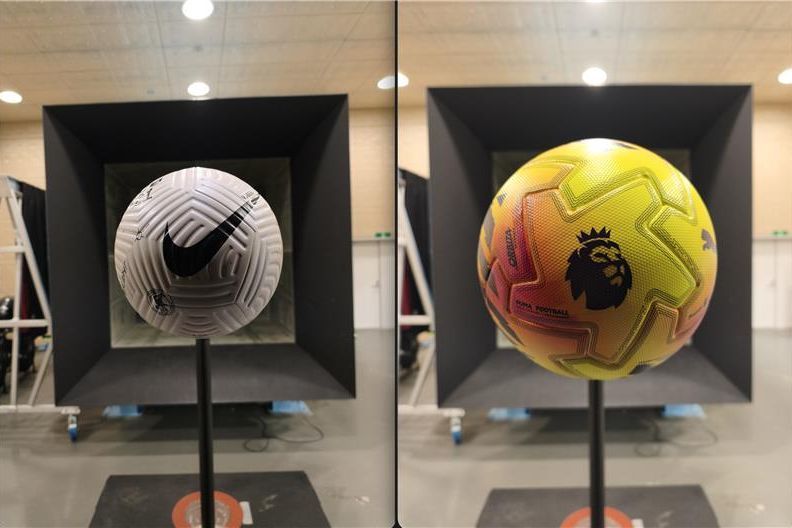 Goff tested the balls in wind tunnels -- Nike Flight on the left, new Puma on the right -- to see how differently they behaved.
The paper was published in the European Journal of Physics. From there Goff became the guy you talk to when you want to understand how balls and athletes and rackets and sticks and feet bound and bounce and slap and leap and skid. He wrote a book called "Gold Medal Physics: The Science of Sports," and he got his first call from NPR in 2010 for a segment with a really unfortunate headline: "What Physics Says About Smooth Balls."
At the 2010 World Cup, FIFA introduced a new Adidas ball called the "Jabulani" ... and almost everyone hated it.
"The new model is absolutely inadequate and I think it's shameful [to] play such an important competition, where a lot of champions take part, with a ball like this," said Italy goalkeeper Gianluigi Buffon. Brazil striker Luis Fabiano called its movements "supernatural," while Brazil keeper Julio Cesar said the ball was "horrible and looks like the ones sold in supermarkets."
Now take a second to think about those hollow, bouncy balls you might buy at a supermarket. When you kick a soccer ball, it generally seems to obey the laws of physics. Create rightward spin; the ball curves to the right, and vice versa. But if you've kicked one of the supermarket balls before, you know what happens: basically anything. The ball sort of just moves chaotically and unpredictably through the air. It moves, say, kind of like the ball did on Keisuke Honda's free kick goal against Denmark at the 2010 World Cup.
There were a number of other supernatural, supermarket-seeming strikes in South Africa, but there still wasn't really an explanation for why -- until Goff and a group of mechanical engineers in Japan figured it out. The engineers tested the Jabulani and other World Cup balls by blasting them with air in a high-speed wind tunnel. They then sent the results to Goff, the physicist, who took all of the datapoints and modeled what it all meant for how each ball would fly through the air.
What Goff and his team found then -- and in the years since -- is that almost all of the World Cup balls exhibit quite similar aerodynamic characteristics.
You have two main factors: the speed of the ball and the drag coefficient. The latter is essentially the effect the air is having on the stability of the flight of the ball and for most of the World Cup balls, the drag coefficient is minimal from around 35 miles per hour and beyond. So, the ball is mostly stable at high speed, until it reaches a really low speed where any perturbations aren't even noticeable.
And then there was the Jabulani, which had an even lower drag coefficient at higher speeds than all of the other balls, but then suddenly gained a much higher drag coefficient right around 55 miles per hour. That meant you had a ball that was easier to kick farther, but then also became unstable at a much higher speed. You had a ball, then, that might do exactly what it did for Honda.
So what made the Jabulani such an outlier?
"Essentially, it was too smooth," Goff said. The Jabulani only had eight panels, compared to 16 or 32 used in previous balls, and then stitching on the ball was barely noticeable. Adidas has since moved to just six panels in recent tournaments, but the stitching on the newest balls is much more prominent. Any imperfections help to stabilize a ball's drag coefficient until it reaches lower speeds.
"This is what happens when you make balls rougher," Goff said. "You move that transition point. So golf balls without dimples, baseballs, without stitches, all these balls -- if they were smooth, they would never fly anywhere near the distances that they do now."
When we first spoke, Goff held up both the new Puma Orbita ball from the current Premier League season and the Nike Flight ball from last year. The Nike ball, he pointed out, had deeper grooves and rougher paneling. The Puma ball, though, was much smoother.
How the new Puma ball changed the Premier League
A week later, we had the test results and Goff was right. The smoother Puma ball does what the Jabulani did: carries farther and destabilizes earlier than its predecessor.
Here's how that looks on a chart:
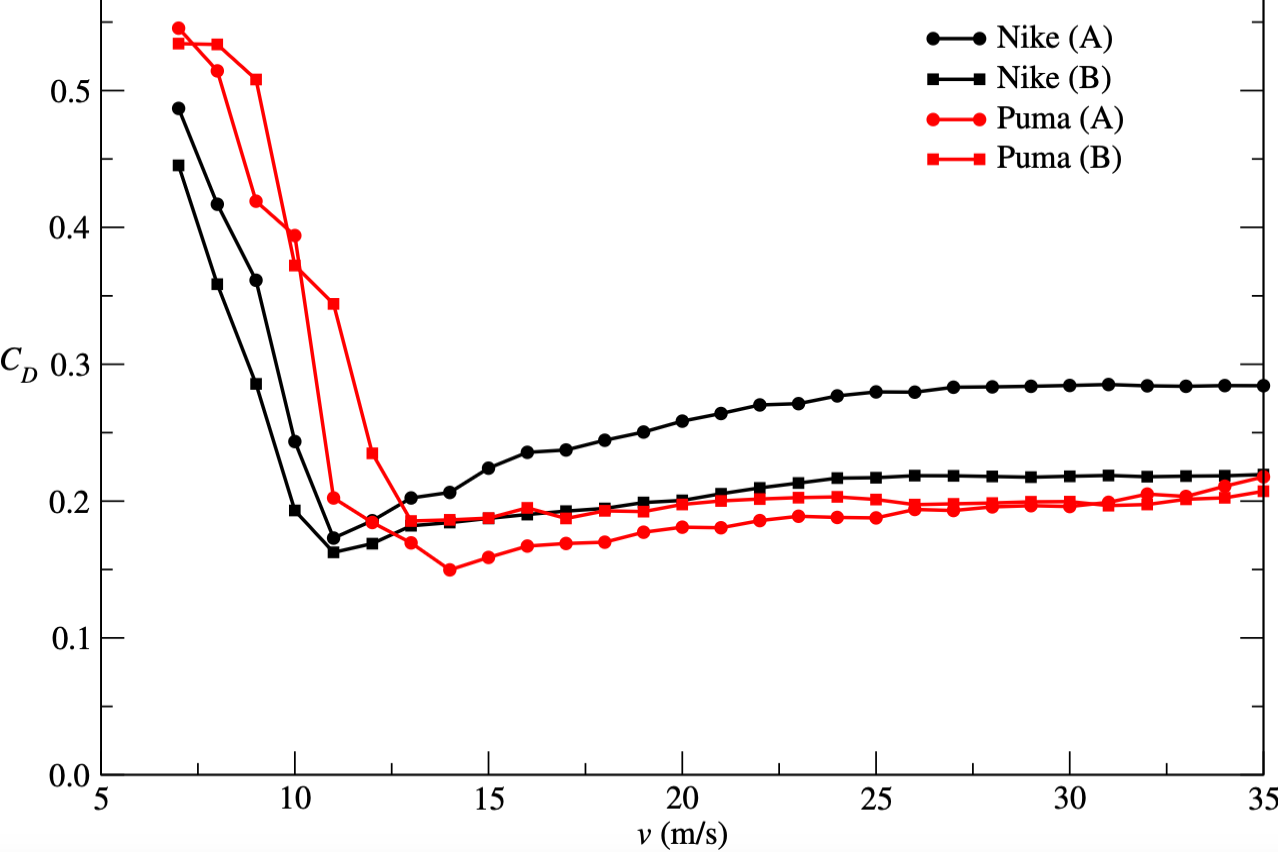
There we have it! The smoking gun? Well, not quite.
Goff & Co. just released a paper about the 2026 World Cup ball, "Trionda: Enhanced Surface Roughness Relative to Previous FIFA World Cup Match Balls" in the journal Applied Sciences. Here's how the Jabulani compares to the Trionda and all of the other subsequent World Cup balls.
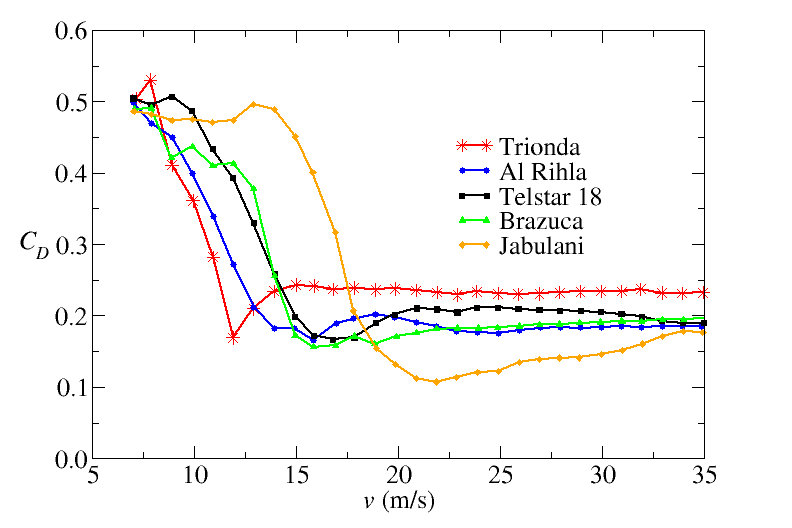
The difference between the Nike and Puma balls is real, but not enough to create the beach-ball effect we saw back in 2010. The Puma ball can fly a little further and although it destabilizes earlier, it still is only destabilizing at a quite-low speed. However, this tracks with what players and managers have been saying throughout the season -- and before.
"We kicked a lot of balls over the bar, and it's tricky that these balls fly a lot so there's details that we can do better," Arsenal manager Mikel Arteta said about the Puma ball, when it was used during last season's Carabao Cup.
After giving up this goal ...
... Arsenal keeper David Raya said: "It's a very good strike especially with the new balls and everything. We still have to adapt. It's going away from me so it's harder to gauge and save it."
Aston Villa's John McGinn joked about all of Rogers' long-range goals: "It's cheating, isn't it? Because he's got a Puma deal. So he got to experience of the ball before we did."
Manchester City manager Pep Guardiola called the ball "tricky," with then-Nottingham Forest manager Sean Dyche mentioning that it was "a bit lighter."
Athletes are creatures of habit. Incredibly fine margins affect everything they do, and they're going to recognize minute changes like this. So maybe that explains the progression of the trend itself. The rate of long-range scoring was much higher a few months ago, and it's dropped over the past few months:
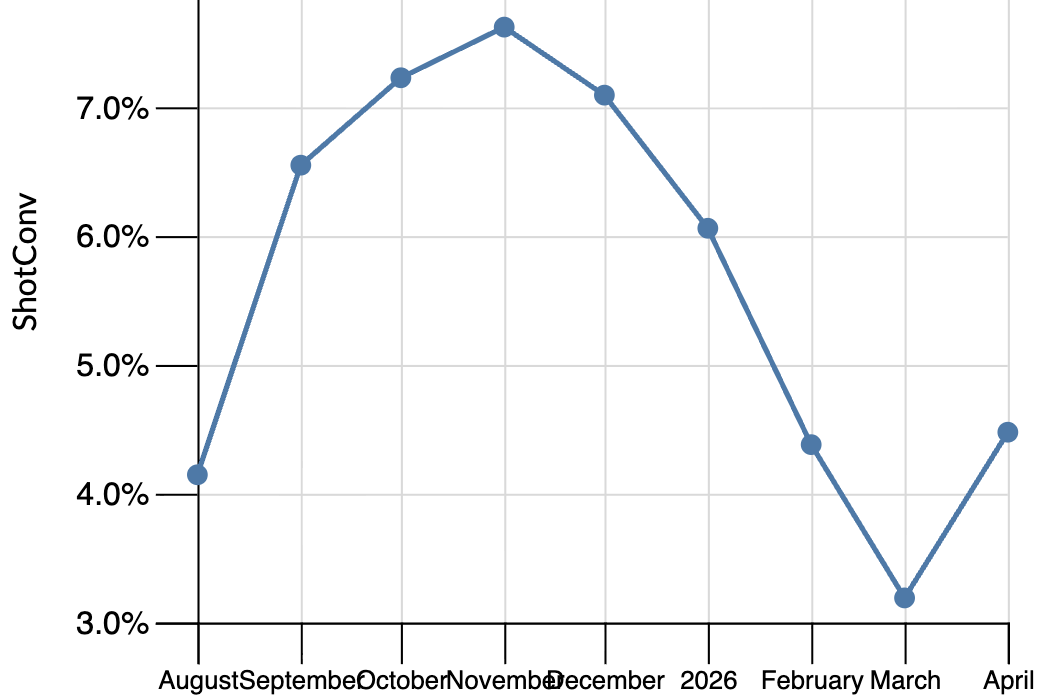
The long-range barrage has slowed down, and while it's tempting to write that off as randomness, could it actually be that everyone has finally adjusted to the ball?
I asked the Premier League about the considerations that went into changing from Nike to Puma. They declined to comment, instead directing me to a press release about the most recent colorway of the Puma ball. It's filled with corporate gibberish and doesn't address much about the actual performance characteristics of the round thing that makes the game go. The drag coefficient, of course, had nothing to do with it.
No one was upset with the Nike ball -- no one ever even really talked about the Nike ball. The only reason for the league to change was because a new ball means more money.
The same thing is true for why the World Cup ball is different every year -- even as Goff and his colleagues have discovered no notable differences between how the last three or four have actually performed.
Ironically, Goff told me, the ball being used for the 2026 World Cup this summer, the Trionda, is very similar to the Premier League ball ... from last season. That was true both for the surface of the balls with their deep grooves, and for the results of the aerodynamic testing.
"That's making us wonder if the Trionda and Nike Flight are possibly going to be seen by the players as not traveling quite as far," he said.
If you've enjoyed the higher share of long-range goals from this Premier League season, then don't expect it to continue into the World Cup. The first time someone finds a little bit of space during the group stage, rolls the ball forward, puts his head down, and lines up to let it rip? The ball is probably going to do what we've already grown used to seeing it do: end up in the hands of the other team.
:strip_icc():format(jpeg):watermark(kly-media-production/assets/images/watermarks/bola/watermark-color-landscape-new.png,1125,20,0)/kly-media-production/medias/5542153/original/044374100_1774935257-20260330IQ_Timnas_Indonesia_vs_Bulgaria-69.jpg)
:strip_icc():format(jpeg)/kly-media-production/medias/5379799/original/022623000_1760369125-20251003BL_Timnas_Indonesia_U-22_Vs_India_Uji_Coba_4.jpg)
:strip_icc():format(jpeg)/kly-media-production/medias/4838391/original/066119600_1716272142-000_346E6AD.jpg)
:strip_icc():format(jpeg)/kly-media-production/medias/7361507/original/044030800_1780142366-WhatsApp_Image_2026-05-30_at_18.26.29.jpeg)
:strip_icc():format(jpeg):watermark(kly-media-production/assets/images/watermarks/bola/watermark-color-landscape-new.png,1125,20,0)/kly-media-production/medias/5545834/original/016922400_1775213023-timnas_Indonesia_bulgaria-2.jpg)
:strip_icc():format(jpeg):watermark(kly-media-production/assets/images/watermarks/bola/watermark-color-landscape-new.png,1125,20,0)/kly-media-production/medias/7325619/original/085805000_1780110721-20260530_094442.jpg)
:strip_icc():format(jpeg)/kly-media-production/medias/7081273/original/056441800_1779861808-Gemini_Generated_Image_2fvdf42fvdf42fvd.jpg)
:strip_icc():format(jpeg):watermark(kly-media-production/assets/images/watermarks/bola/watermark-color-landscape-new.png,1125,20,0)/kly-media-production/medias/5559080/original/077819100_1776509623-rivera_2.jpg)
:strip_icc():format(jpeg):watermark(kly-media-production/assets/images/watermarks/bola/watermark-color-landscape-new.png,1125,20,0)/kly-media-production/medias/5666310/original/091944700_1778358722-20260509AA_Final_Pegadaian_Championship-5.jpg)
:strip_icc():format(jpeg):watermark(kly-media-production/assets/images/watermarks/bola/watermark-color-landscape-new.png,1125,20,0)/kly-media-production/medias/5174403/original/065556600_1742924674-20250325BL_Timnas_Indonesia_Vs_Bahrain_Kualifikasi_Piala_Dunia_2026-46.JPG)
:strip_icc():format(jpeg):watermark(kly-media-production/assets/images/watermarks/bola/watermark-color-landscape-new.png,1125,20,0)/kly-media-production/medias/4370765/original/005760600_1679670315-20230324BL_BRI_Liga_1_2022-2023_Persib_Bandung_vs_Bhayangkara_FC_10.jpg)
:strip_icc():format(jpeg)/kly-media-production/medias/5339804/original/065245700_1757130047-timnas_3.jpg)
:strip_icc():format(jpeg):watermark(kly-media-production/assets/images/watermarks/bola/watermark-color-landscape-new.png,1125,20,0)/kly-media-production/medias/7339649/original/083452800_1780123190-20260530_105743.jpg)
:strip_icc():format(jpeg):watermark(kly-media-production/assets/images/watermarks/bola/watermark-color-landscape-new.png,1125,20,0)/kly-media-production/medias/4781588/original/045983700_1711120094-20240322AA_Timnas_Indonesia_U-20_Vs_China_U-20-13.jpg)
:strip_icc():format(jpeg):watermark(kly-media-production/assets/images/watermarks/bola/watermark-color-landscape-new.png,1125,20,0)/kly-media-production/medias/7336618/original/055797600_1780120424-20260530_105918.jpg)
:strip_icc():format(jpeg):watermark(kly-media-production/assets/images/watermarks/bola/watermark-color-landscape-new.png,1125,20,0)/kly-media-production/medias/4747121/original/067573600_1708349006-20240219BL_Latihan_Timnas_Indonesia_U-16__14.JPG)
:strip_icc():format(jpeg):watermark(kly-media-production/assets/images/watermarks/bola/watermark-color-landscape-new.png,1125,20,0)/kly-media-production/medias/4371315/original/023919400_1679730830-20230324BL_BRI_Liga_1_2022-2023_Persib_Bandung_vs_Bhayangkara_FC_31.jpg)
:strip_icc():format(jpeg):watermark(kly-media-production/assets/images/watermarks/bola/watermark-color-landscape-new.png,1125,20,0)/kly-media-production/medias/5553221/original/069160700_1775917624-persija_vs_persebaya-07.jpg)
:strip_icc():format(jpeg)/kly-media-production/medias/7335427/original/018747300_1780119426-ATK_BOLANET_HSS_ROOKIE_FIGHT_HOW_TO_BUY.jpg)
:strip_icc():format(jpeg)/kly-media-production/medias/6963622/original/019730000_1779729236-HJLdgZHbkAA1f3o.jpg)